-
Vidrio fundido en tanques de acero (596)
-
los tanques de acero inoxidables (434)
-
La fusión enlazó los tanques de epoxy (592)
-
Tanques de acero galvanizado (321)
-
Tejados de aluminio de la bóveda (1316)
-
Tanques de almacenamiento de aguas residuales (231)
-
tanques de acero soldados (457)
-
Recipientes del reactor (295)
-
Digestor anaerobio (201)
-
Los tanques de agua industriales (349)
-
Tanques de acero revestidos de vidrio (180)
-
Los tanques de acero empernados (390)
-
El tanque de almacenamiento del barro (115)
-
El tanque de almacenamiento del biogás (173)
-
Tanques de almacenamiento de lixiviación (133)
-
Tanques de almacenamiento de agua agrícola (179)
-
Tanque de agua de fuego (166)
-
Silos de almacenamiento de cereales (146)
-
Proyectos de biogás (425)
-
Proyectos del tratamiento de aguas residuales (788)
-
Techo de doble membrana (223)


|
Proyectos de Biogás Premium y Tanques GFS para el Tratamiento de Aguas Residuales de Granjas Avícolas en Singapur
| Lugar de origen: | Porcelana |
| Nombre de la marca: | CEC TANKS |
| Certificación: | ISO 9001:2008, AWWA D103 , OSHA , BSCI |
| Número de modelo: | W. |
| Cantidad de orden mínima: | 1 juego |
| Precio: | $5000~$20000 one set |
| Detalles de empaquetado: | Espuma de polietileno entre cada dos placas de acero; palet de madera y madera |
| Tiempo de entrega: | 10-30 días después de recibir el depósito |
| Condiciones de pago: | LC, T/T |
| Capacidad de la fuente: | 60 juegos por mes |
|
Información detallada |
|||
| Lugar de origen | Porcelana | Nombre de la marca | CEC TANKS |
|---|---|---|---|
| Certificación | ISO 9001:2008, AWWA D103 , OSHA , BSCI | Número de modelo | W. |
| Color de la carrocería del tanque: | Verde oscuro / se puede personalizar | Integridad de corrosión: | Excelente |
| Grosor de placas de acero: | 3 mm a 12 mm, depende de la estructura del tanque | Resistencia química: | Excelente |
| Tamaño del panel: | 2.4m * 1.2m | Fácil de limpiar: | Suave, brillante, inerte, anti-adhesión |
| Resaltar: | Proyectos de tratamiento de aguas residuales de biogás,Tanques GFS para granjas avícolas,Soluciones de tratamiento de aguas residuales en Singapur |
||
Descripción del producto
Proyectos premium de biogás y tanques de GFS paraSingapurTratamiento de aguas residuales de las granjas avícolas
En Singapur, donde la tierra es un recurso de primera calidad y la sostenibilidad ambiental es una prioridad nacional central, el sector agrícola se enfrenta a desafíos únicos en la gestión de los residuos orgánicos.A medida que la nación avanza en su objetivo de seguridad alimentaria "30 por 30", la implementación de proyectos a gran escalaProyectos de biogásLa transformación de los residuos en energía renovable se ha convertido en una necesidad estratégica.Tanques de vidrio fundido en acero (GFS)Las instalaciones agrícolas modernas están convirtiendo con éxito los pasivos medioambientales en activos de energía limpia.
Los desafíos de Singapur con los residuos agrícolas
Si bien la industria ganadera de Singapur está muy modernizada, el camino hacia una industria ganadera eficienteTratamiento de aguas residuales agrícolasEl principal desafío radica en la elevada carga orgánica de estiércol y en la naturaleza corrosiva de los efluentes,que pueden degradar rápidamente la infraestructura de calidad inferior.
Además, el clima tropical de Singapur, caracterizado por una alta humedad y lluvias constantes, exige soluciones robustas y resistentes a los ácidos que puedan implementarse rápidamente en zonas limitadas.Como protagonistaEnvases de biogásel fabricante, Center Enamel, proporciona sistemas de contención de grado industrial que abordan estos desafíos específicos,Ayudar a las empresas agrícolas locales a cumplir con estrictos estándares medioambientales al tiempo que se asegura la energía descentralizada.
El flujo de producción y utilización de biogás
La conversión de aguas residuales orgánicas en energía verde es un proceso biológico controlado con precisión.el flujo de producción integra varias etapas críticas y equipos especializados:
Recolección de materias primas: Se recolectan estiércol crudo y agua de lavado de la instalación para garantizar una carga orgánica estable.
Digestión anaeróbica (el reactor): El núcleo del proceso ocurre en el reactor, típicamente un reactor deEl depósito de GFSEn un ambiente sin oxígeno, los microorganismos especializados descomponen la materia orgánica para producir metano.
Captura y almacenamiento de gas: El gas rico en metano es capturado por medio de un sistema de alta integridadcontenedores de biogás(como los techos de doble membrana) montados directamente sobre los tanques para mantener una presión constante.
Condicionamiento y uso: Antes de su utilización, el gas se deshidrata y desulfura para eliminar la humedad y los sulfuros.
Generación de energía de biogás: El metano se quema para impulsar los generadores de electricidad limpia.
Calderas: La combustión directa proporciona energía térmica para instalaciones industriales o agrícolas.
Sistemas de llamaradas: Estos garantizan la seguridad liberando presión cuando la producción de gas excede la capacidad de almacenamiento o utilización.
Gas natural comprimido (GNC): El gas se purifica a más del 95% de metano y se comprime para su uso como combustible de alta calidad.
Tanques GFS de esmalte central: material y ventajas principales
En el exigente entorno de la digestión anaeróbica, el material del reactor determina directamente el éxito a largo plazo del proyecto.Envases de cristal fundido en acero (GFS) de enmalladura centralson el estándar mundial de la industria para la infraestructura de biogás:
Resistencia a la corrosión superior: El revestimiento de vidrio fundido a temperaturas superiores a 800°C crea una barrera inerte y no porosa, inmune a los altos niveles de amoníaco y ácidos orgánicos típicos de los desechos de ganado.
Instalación modular rápida: El diseño con tornillos elimina la soldadura compleja en el lugar, lo que permite un montaje rápido en zonas urbanas o rurales confinadas.
Bajo mantenimiento y durabilidad: Diseñados para condiciones extremas, los tanques GFS ofrecen una vida útil de más de 30 años con costes de mantenimiento muy bajos en comparación con las alternativas de hormigón o acero al carbono.
Cumplimiento estándar: Nuestros tanques cumplen o exceden las normas internacionales de diseño como AWWA D103-09 e ISO 28765, garantizando seguridad y fiabilidad en cualquier clima.
Procesos de ingeniería de precisión: CSTR, USR y UASB
Para maximizar el rendimiento de gas de diversas cargas agrícolas, el Centro Enamel apoya varios procesos biológicos anaeróbicos de alta tasa:
CSTR (reactor de tanque completamente mezclado)Los mezcladores mecánicos mantienen un ambiente homogéneo, impidiendo que los sólidos se depositen y maximizando la actividad microbiana.
USR (reactor de sólidos de flujo ascendente): Específicamente optimizado para aguas residuales con altas concentraciones de sólidos en suspensión (SS), garantizando una digestión completa de la materia orgánica compleja.
UASB (cubierta de lodo anaeróbico de flujo ascendente): Proceso de alta eficiencia ideal para los efluentes líquidos, que permite una rápida degradación en una huella compacta mediante el flujo de aguas residuales a través de una densa cubierta de lodos granulares.
Desempeño comprobado: excelencia en infraestructuras globales
La tecnología de Center Enamel® está verificada por proyectos de alto rendimiento en diversos climas y estándares ambientales.
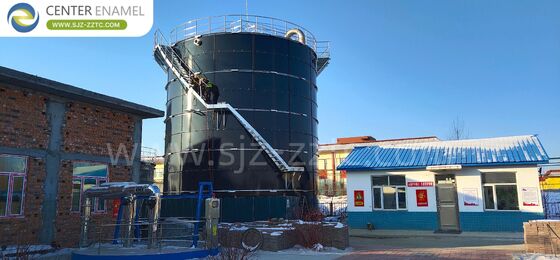
1Proyecto de biogás en Mongolia Interior
Este caso pone de relieve la versatilidad de los tanques de GFS para mantener una fermentación estable en condiciones climáticas extremas.
Ubicación: Región autónoma de Mongolia Interior, China.
Fecha de instalación: 2013.
Tecnología:Proceso de CSTRLas empresas de la industria del automóvilSistema de aislamiento.
Lo más destacado: El aislamiento garantiza una alta actividad microbiana y una producción constante de gas incluso a temperaturas de congelación, lo que demuestra la fiabilidad estructural y térmica de los tanques.
2Proyecto de biogás en Indonesia
Este proyecto demuestra la aplicación de la tecnología GFS en el tratamiento de aguas residuales industriales a gran escala en un clima tropical.
Aplicación en el tanque: Planta de tratamiento de aguas residuales de las fábricas de aceite de palma (POME).
Modelo de tanque: Ø19.86 × 8.4 metros
Cantidad: 3 juegos de tanques GFS.
Fecha de instalación: noviembre de 2009.
Conclusión: Colaboración para un futuro más verde
Para los operadores agrícolas de Singapur y de todo el mundo, la transición a una gestión sostenible de los residuos es tanto una responsabilidad ambiental como una oportunidad económica.Al combinar la resiliencia estructural de losEnvases de GFScon avanzadoTecnología del biogás, Center Enamel (Zhengzhong Technology) ofrece una solución integral paraTratamiento de aguas residuales agrícolasCon más de 30 años de experiencia y proyectos en más de 100 países, nos dedicamos a ayudar a las granjas a convertir los desechos agrícolas en un futuro energético sostenible.